


My First Trek to Poon Hill: A Journey That Changed My Life
2026-06-08 21:20 PMMore than twenty years have passed since my first trek to Poon Hill, yet the memories remain as vivid as the morning sunlight that illuminated the Himalayan peaks on that unforgettable day.
It was April 10, 2002. Around four o'clock in the afternoon, I was sitting in my small room, working on college assignments, when I heard a knock at the door. A familiar voice called from outside.
“Brother, come out for a moment.”
I opened the door and found Suraj Neupane, a senior colleague from the hotel where I had previously worked. Although we no longer worked together, fate occasionally brought us together, and this was one of those moments.
What he told me that day would unexpectedly become the beginning of one of the most treasured memories of my life.
Our former employer, Bodharaj Bhandari, had booked a Poon Hill trek for a group of foreign guests and was looking for a porter. He had recommended me for the job.
At only sixteen or seventeen years old, I had never been on a real trekking expedition. Apart from a short hike to Sarangkot, the mountains beyond Pokhara were still a mystery to me. Nevertheless, I accepted the opportunity without hesitation.
The following morning, Suraj Dai arrived at my room accompanied by his wife. I did not even own a trekking backpack, so she kindly suggested packing my clothes into her husband's bag. Looking back today, that small gesture represented the warmth and generosity that would accompany me throughout my journey in Nepal's trekking industry.
Soon afterward, we arrived at Manipal Hospital, where three British female doctors were waiting. They were in Nepal for their medical internship and had chosen to spend their free time exploring the Annapurna region.
Seeing everyone carrying their own backpacks made me nervous. I worried they might not need a porter at all. Fortunately, they assured me that I would assist anyone who needed help during the trek.
With that reassurance, our adventure began.
We traveled to Nayapul by taxi and started walking along the Modi Khola Valley. In those days, there were no roads stretching deep into the mountains as there are today. The trail was alive with mule caravans carrying supplies between villages.
After lunch in Birethanti, we followed the trail toward Tikhedhunga. The route wound through terraced fields, waterfalls, quiet forests, and traditional villages. Every turn revealed something new. Sometimes we stopped at tiny teahouses, where local people welcomed us with smiles and occasionally offered fresh buffalo buttermilk.
For a young boy experiencing mountain life for the first time, everything felt extraordinary.
By evening, we reached Tikhedhunga and began climbing the famous stone staircase toward Ulleri.
The climb seemed endless.
Yet what amazed me most was watching our British guests move steadily upward without complaint. My English was limited, but whenever I made jokes in Nepali, our guide translated them. Their laughter bridged the language barrier, reminding me that friendship often requires no common language at all.
We spent the night in a traditional wooden lodge in Ulleri. The building creaked whenever people walked upstairs, and the mountain air felt much colder than Pokhara. During dinner, our guests looked on with amusement as we Nepalis continued refilling our plates with rice.
The next morning rewarded us with magnificent views across the valley below. Standing outside the lodge, I looked back at the ridges and hills we had crossed and felt a growing sense of accomplishment.
Today, vehicles can reach Ulleri. While this has made travel easier, it is difficult to recreate the adventure and anticipation of those earlier days.
From Ulleri we continued toward Ghorepani, passing Banthanti and Nangethanti. The forests were bursting with blooming rhododendrons, painting the hillsides in brilliant shades of red.
There were no smartphones then.
No social media.
No digital photographs.
The memories survive only within my heart.
We reached Ghorepani in the early afternoon beneath cloudy skies. The weather was cold enough to discourage bathing, but somehow I felt inspired to wash away the dust of the trail.
The experience became unforgettable when boiling hot water suddenly emerged from the tap after I had already covered myself in soap. Not knowing how to adjust the water system, I stood shivering while waiting for a bucket of water to cool. Even today, the memory makes me laugh.
That evening we gathered around the warm dining hall stove, played cards, shared stories, and prepared for the highlight of the trek.
At four o'clock the next morning, we woke in darkness and began the steep climb toward Poon Hill.
This was the moment we had all been waiting for.
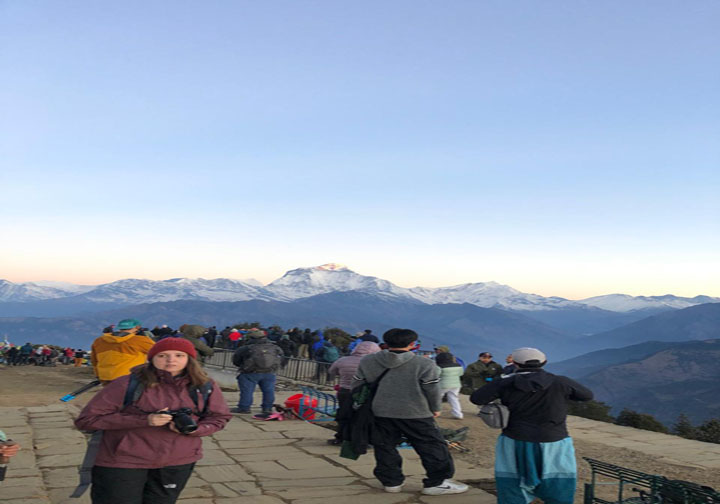
An hour later, we reached the summit before sunrise.
Then the mountains revealed themselves.
To the north stretched an endless panorama of snow-covered giants—Dhaulagiri, Annapurna, Manaslu, and countless other Himalayan peaks glowing beneath the first light of dawn.
The hills below were carpeted with red rhododendrons.
The sky was crystal clear.
The air felt pure and timeless.
For a young boy who had never ventured far into the mountains, the sight was overwhelming.
I stood there speechless.
Around me, visitors from around the world gazed at the same magnificent landscape with wonder in their eyes.
At that moment, I understood why people travel thousands of miles to visit Nepal.
Poon Hill was not simply a viewpoint.
It was a place where nature revealed its greatness.
After returning to the lodge for breakfast, we continued toward Ghandruk. One of our guests became unwell during the journey, and for the first time I carried her backpack. Sharing chocolates along the trail and helping where I could, I began to understand the true meaning of hospitality and service.
The route led through forests, waterfalls, and beautiful mountain scenery before descending to the famous Gurung village of Ghandruk.
The next morning happened to be Baisakh Sankranti, the Nepali New Year celebration. The lodge owner welcomed us with tika, creating yet another cherished memory.
We explored the village, admired the views of Annapurna and the Modi Valley, and eventually completed a circular route back to Birethanti before returning to Pokhara.
Today, more than two decades later, I have guided and accompanied trekkers to Poon Hill countless times.
The trails have changed.
Roads have been built.
Technology has transformed travel.
Yet whenever I return, I still see the mountains through the eyes of that sixteen-year-old boy experiencing the Himalayas for the very first time.
Many treks have followed.
Many adventures have come and gone.
But my first trek to Poon Hill remains the journey that changed my life forever.