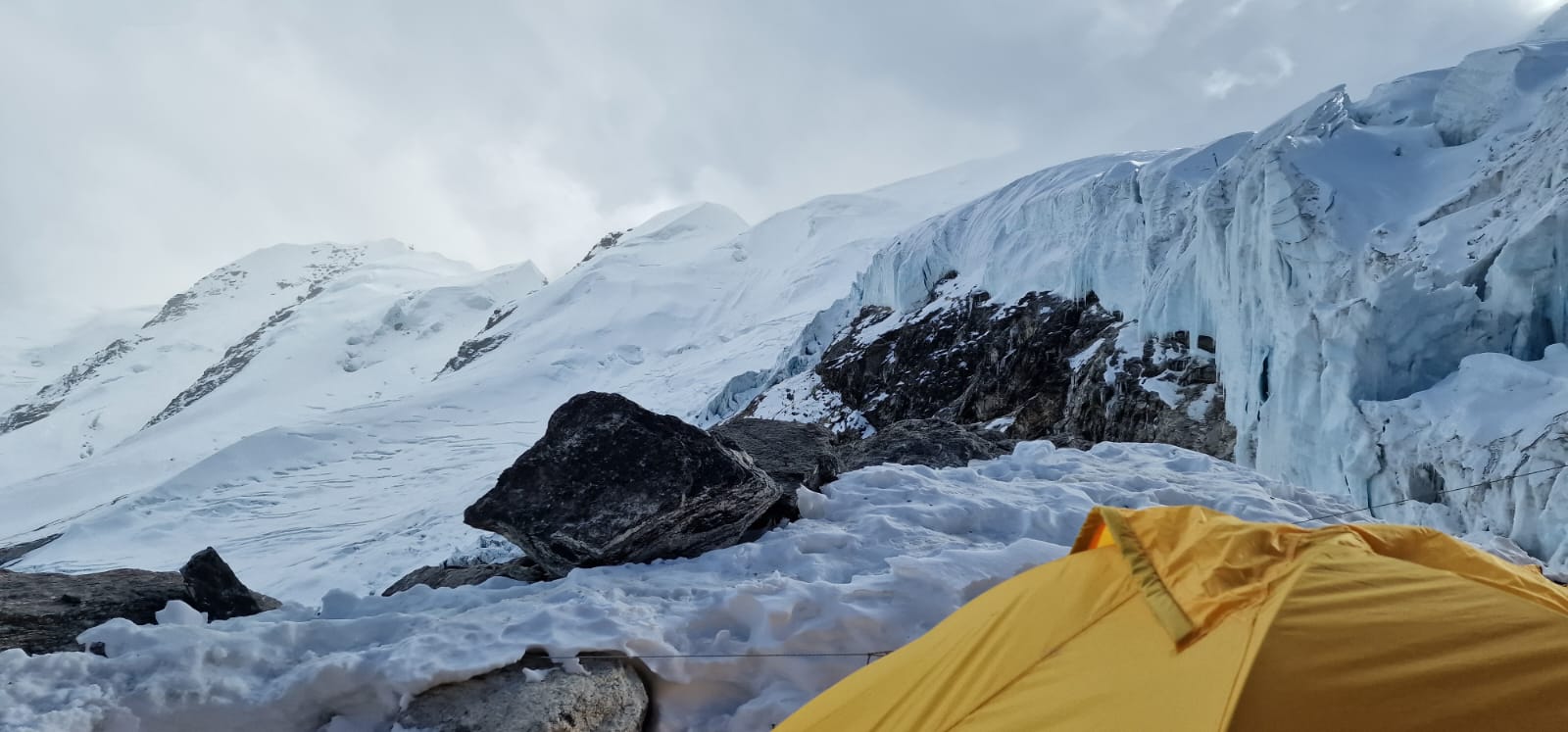

Join us at Merriment Travels and Tours for a journey that promises unforgettable memories and breathtaking experiences on Mera Peak.
Mera Peak climbing is a sought-after adventure for avid climbers and trekkers, standing tall at 6,476 meters (21,247 feet) in the Everest region of Nepal. This expedition offers a perfect blend of thrill and natural beauty, making it an ideal challenge for those looking to summit one of Nepal's highest trekking peaks. Mera Peak is renowned for its panoramic views, where climbers can witness five of the world's highest mountains, including Everest, Lhotse, Makalu, Cho Oyu, and Kangchenjunga. The climb, while non-technical, requires good physical fitness and acclimatization, which Merriment Travels and Tours expertly facilitates.
Our Mera Peak climbing itinerary is meticulously designed to ensure climbers have ample time for acclimatization, significantly reducing the risk of altitude sickness. The journey begins with a scenic flight to Lukla, followed by a trek through picturesque Sherpa villages, lush forests, and alpine meadows. This gradual ascent allows trekkers to enjoy the serene beauty of the Hinku Valley while adjusting to the altitude. At Merriment Travels and Tours, we prioritize your safety and success, providing high-quality equipment and experienced guides who are well-versed in high-altitude trekking.
Choosing Mera Peak climbing with Merriment Travels and Tours means more than just an adventure; it's an immersion into the rich culture and hospitality of the Sherpa people. The trek offers opportunities to explore traditional villages and interact with locals, providing a deeper understanding of their unique way of life. Our ethical and sustainable approach ensures that we support local communities and preserve the pristine environment of the Himalayas. By trekking with us, you contribute to responsible tourism that benefits both the environment and the local economy.
Whether you are an experienced climber or a passionate trekker looking for your next big challenge, Mera Peak climbing offers an unforgettable experience. The sense of achievement upon reaching the summit, combined with the breathtaking views and cultural encounters, makes this expedition a highlight for any adventure enthusiast. Merriment Travels and Tours is committed to making your Mera Peak climb a safe, enjoyable, and memorable journey, providing you with professional support every step of the way. Book your adventure today and embark on the ultimate Himalayan climbing experience with us.
Day 1: Arrival in Kathmandu and Transfer to Hotel
Maximum Altitude: 1,400 m / 4,593 ft
Meals: Breakfast
Accommodation: Hotel
Welcome to Nepal. Our representative will meet you at Tribhuvan International Airport and transfer you to your hotel in Kathmandu. After check-in, you can rest or take a short walk around the city. If you arrive early, there may be time to meet your climbing guide and discuss the upcoming journey.
Day 2: Kathmandu – Climbing Preparation and Briefing
Maximum Altitude: 1,400 m / 4,593 ft
Meals: Breakfast
Accommodation: Hotel
Today is set aside for final preparation. Your guide will check your climbing equipment and explain the trekking and climbing plan. You can rent or purchase any missing equipment in Kathmandu. The team will also complete the necessary permit and documentation formalities before the expedition begins.
Day 3: Kathmandu to Ramechhap and Flight to Lukla
Altitude: Lukla 2,860 m / 9,383 ft
Meals: Breakfast, Lunch, Dinner
Accommodation: Lodge
Depending on the flight schedule, you will travel from Kathmandu to Ramechhap and continue by flight to Lukla. The short mountain flight offers impressive views as you approach the small airstrip. After arriving in Lukla, you will meet the local support team and have time to rest and prepare for the trek.
Flight operations can change because of weather and airline schedules.
Day 4: Lukla to Chutanga
Altitude: 3,050 m / 10,006 ft
Trekking: Approximately 4–5 hours
Meals: Breakfast, Lunch, Dinner
Accommodation: Lodge
The trek begins with a gradual walk through forested hills. The trail passes through small settlements and quiet woodland before reaching Chutanga. This relatively short day gives your body time to begin adjusting to the increasing altitude.
Day 5: Chutanga to Thuli Kharka via Zatrawala Pass
Highest Point: Zatrawala Pass, around 4,600 m
Trekking: Approximately 6–7 hours
Meals: Breakfast, Lunch, Dinner
Accommodation: Lodge
Today is one of the more demanding trekking days. The trail climbs toward Zatrawala Pass, where you can enjoy views of the surrounding mountains before descending toward Thuli Kharka. The descent is steep in sections, so careful walking is important.
Day 6: Thuli Kharka to Kothe
Altitude: Around 3,600–3,700 m
Trekking: Approximately 5–6 hours
Meals: Breakfast, Lunch, Dinner
Accommodation: Lodge
The trail gradually enters the Hinku Valley. You will walk through rhododendron and pine forests with occasional views of the surrounding peaks. Kothe is a small settlement where you spend the night before continuing deeper into the Mera region.
Day 7: Kothe to Thangnak
Altitude: 4,350 m / 14,272 ft
Trekking: Approximately 4–5 hours
Meals: Breakfast, Lunch, Dinner
Accommodation: Lodge
Today the trail follows the Hinku Valley toward Thangnak. As you gain altitude, the landscape becomes more rugged and alpine. On a clear day, you may get your first impressive views of Mera Peak. The shorter walking day also helps with acclimatization.
Day 8: Acclimatization Day at Thangnak
Altitude: 4,350 m / 14,272 ft
Meals: Breakfast, Lunch, Dinner
Accommodation: Lodge
A rest and acclimatization day is important before moving higher. Rather than staying completely inactive, you will take a gradual hike around the area and return to Thangnak to sleep. Your guide will also monitor how you are responding to the altitude and discuss the next stage of the climb.
Day 9: Thangnak to Khare
Altitude: 5,045 m / 16,551 ft
Trekking: Approximately 4–5 hours
Meals: Breakfast, Lunch, Dinner
Accommodation: Lodge
The trail continues toward Khare, the main preparation point for the Mera Peak climb. The landscape becomes increasingly rocky and barren as you move above the tree line. After reaching Khare, your guide will check your climbing equipment and prepare you for the next stage.
Day 10: Acclimatization and Climbing Practice at Khare
Altitude: Around 5,045 m / 16,551 ft
Meals: Breakfast, Lunch, Dinner
Accommodation: Lodge
Today is dedicated to acclimatization and basic climbing practice. Depending on conditions, your climbing guide will provide practical instruction on using crampons, an ice axe, climbing harness, ropes, and other equipment needed for the glacier and summit sections. This is also a useful day to rest before moving toward higher camps.
Day 11: Khare to Mera Base Camp
Altitude: Around 5,300 m / 17,388 ft
Trekking: Approximately 4–5 hours
Meals: Breakfast, Lunch, Dinner
Accommodation: Camping
You leave Khare and climb toward Mera Base Camp. The trail becomes steeper and more rugged as you approach the glacier area. After reaching base camp, the climbing team will organize the camp and review the plan for the summit attempt.
Day 12: Mera Base Camp to High Camp
Altitude: Around 5,700–5,800 m
Climbing/Trekking: Approximately 5–6 hours
Meals: Breakfast, Lunch, Dinner
Accommodation: Camping
Today you climb toward Mera High Camp. The route may involve glacier travel, depending on current conditions. Your climbing Sherpa will set a suitable pace and manage the technical sections. After reaching High Camp, prepare for an early start on summit day.
Day 13: Mera Peak Summit and Return Toward Khare
Summit: Around 6,461 m / 21,193 ft
Climbing: Approximately 10–14 hours
Meals: Breakfast, Lunch, Dinner
Accommodation: Lodge/Camp
This is the main day of the expedition. You will start very early, usually before sunrise, to allow enough time for the summit attempt. Using crampons and ropes where required, you gradually climb toward the summit.
From the top, you can enjoy a remarkable panorama of Everest, Lhotse, Makalu, Baruntse, Chamlang, and surrounding peaks when visibility is good. After spending a short time at the summit, you descend carefully toward a lower camp, usually continuing toward Khare depending on weather, snow conditions, and the group's condition.
The summit attempt is always subject to weather, snow conditions, route safety, and the judgment of the climbing guide.
Day 14: Khare to Kothe
Altitude: Around 3,600–3,700 m
Trekking: Approximately 5–6 hours
Meals: Breakfast, Lunch, Dinner
Accommodation: Lodge
After the demanding summit day, you retrace the trail toward Kothe. The descent is generally easier on the lungs as you lose altitude, although tired legs can make the day feel long. Enjoy a warm meal and a comfortable night at the lodge.
Day 15: Kothe to Thuli Kharka
Altitude: Around 3,600–3,900 m
Trekking: Approximately 5–6 hours
Meals: Breakfast, Lunch, Dinner
Accommodation: Lodge
Continue through the Hinku Valley and gradually climb toward Thuli Kharka. This is a quieter section of the trek, with forests and mountain scenery along the trail.
Day 16: Thuli Kharka to Lukla via Zatrawala Pass
Altitude: Lukla 2,860 m / 9,383 ft
Trekking: Approximately 7–9 hours
Meals: Breakfast, Lunch, Dinner
Accommodation: Lodge
Your final long trekking day takes you back across Zatrawala Pass before descending toward Lukla. Once you reach Lukla, celebrate the completion of your Mera Peak adventure with your trekking and climbing team.
Day 17: Flight from Lukla to Ramechhap and Drive to Kathmandu
Altitude: Kathmandu 1,400 m / 4,593 ft
Meals: Breakfast, Lunch
Accommodation: Hotel
Take the return flight from Lukla to Ramechhap and continue by road to Kathmandu. After arriving at your hotel, the rest of the day is free for rest, shopping, or exploring Kathmandu.
Day 18: Free Day in Kathmandu and Farewell
Altitude: 1,400 m / 4,593 ft
Meals: Breakfast, Dinner
Accommodation: Hotel
Enjoy a relaxed day in Kathmandu after the expedition. You can explore the city, visit nearby cultural attractions, or simply rest. In the evening, join a farewell dinner with the team and enjoy traditional Nepali food and cultural entertainment.
Day 19: Final Departure
Meals: Breakfast
Your Mera Peak adventure comes to an end today. Depending on your flight schedule, our representative will transfer you to Tribhuvan International Airport for your onward journey.
*****
The Mera Peak Climbing cost starts from US$2,800 per person based on a minimum of 2 people traveling together. The final price depends on the size of your group and the type of service you choose. If you have a larger group or prefer to join a scheduled group, the cost per person can be lower because some expenses are shared among the participants.
The price can also vary depending on your preferred private service and hotel category in Kathmandu. You can choose from different accommodation and service options according to your comfort and budget. Once we know your group size, travel dates, and preferred level of service, we can provide you with a clear and personalized quotation.
Contact us with your group size and preferred travel dates for the best available Mera Peak Climbing price.
Mera Peak requires a climbing permit and other applicable trekking, conservation, and local area permits. The exact fees and requirements can change, so the current regulations should be checked when the booking is confirmed.
Mera Peak is one of the highest trekking peaks in Nepal, standing at 6,476 meters (21,247 feet). It is located in the Solu Khumbu region, south of Mount Everest, and offers stunning panoramic views of the Himalayas, including Everest, Lhotse, Makalu, Cho Oyu, and Kangchenjunga.
The best time to climb Mera Peak is during the pre-monsoon (spring) season from March to May and the post-monsoon (autumn) season from September to November. These periods offer stable weather, clear skies, and favorable conditions for climbing.
Mera Peak climbing is considered moderately difficult. The primary challenges are the high altitude and the need for proper acclimatization. The climb itself is not technically demanding, but it requires a good level of physical fitness and endurance.
While Mera Peak is a non-technical climb, it does require good physical fitness and stamina. It is suitable for enthusiastic trekkers with some experience in high-altitude trekking. No prior technical climbing experience is necessary, but basic knowledge of using crampons and ice axes can be beneficial.
Our standard Mera Peak climbing expedition lasts 17 days, including arrival and departure days in Kathmandu. The itinerary includes ample acclimatization days to ensure climbers adjust to the altitude and minimize the risk of altitude sickness.
Essential equipment for Mera Peak climbing includes crampons, ice axes, harnesses, helmets, and suitable clothing for cold weather. Merriment Travels and Tours provides high-quality climbing gear and equipment, but climbers are advised to bring their personal clothing and trekking gear.
Accommodation during the trek includes teahouses and lodges in villages, providing basic but comfortable facilities. At higher altitudes, especially near the base camp and high camp, we provide high-quality tents and camping gear for a comfortable stay.
Meals are provided throughout the expedition, including a variety of local and international cuisines. Our cooks ensure nutritious and hygienic food to keep you energized and healthy during the trek and climb.
Yes, comprehensive travel insurance is mandatory for Mera Peak climbing. The insurance should cover high-altitude trekking and climbing, medical emergencies, evacuation, and trip cancellations. Please ensure your insurance policy meets these requirements.
Booking your Mera Peak climbing expedition is easy. Visit our website at https://www.merrimenttravels.com, fill out the booking form, or contact us directly via viber whats app at (0977) 9841720005or email at advmountaintreks@gmail.com Our team will guide you through the booking process and provide all necessary information.
Preparation for Mera Peak climbing involves physical training, including cardiovascular exercises, strength training, and endurance activities. It is also beneficial to go on practice hikes and treks at high altitudes. Additionally, climbers should familiarize themselves with basic climbing techniques and equipment usage.
| No of person | Price |
|---|---|
| 2 person | $2800 |
| 3-4 person | $2750 |
| 4 - 6 person | $2700 |
| 6 - 10 person | $2688 |